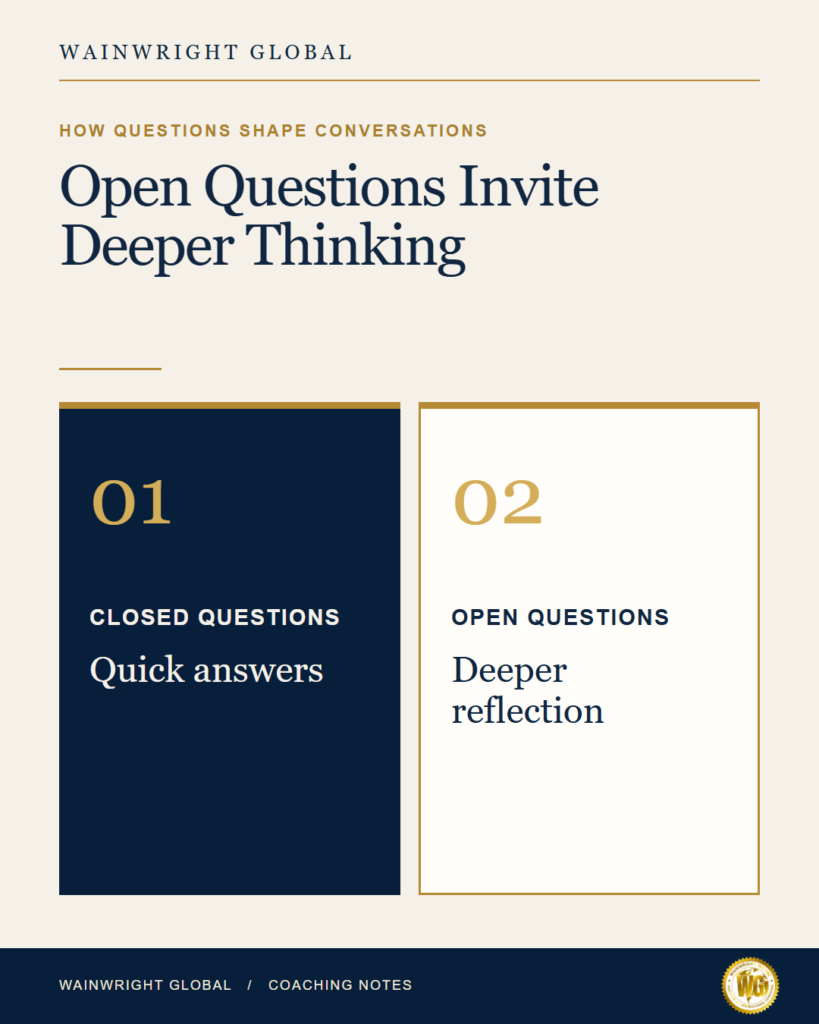
The shape of a question can change the shape of a conversation.
A closed question can usually be answered with a yes, a no, or a single fact. Did you finish the project? Are you happy with your job? These questions have their place. They are useful when you need a quick answer or want to confirm something specific.
An open question works differently. It invites the other person to explore. What part of the project felt hardest? What would make your work feel more satisfying? Questions like these do not point toward a right answer. They give the person room to think out loud and discover what matters to them.
In coaching, open questions are one of the most practical tools available. They keep the focus on the client’s perspective rather than the coach’s assumptions. They also tend to slow the conversation down in a helpful way, because the person has to reflect before they respond.
A simple way to practice is to notice how your questions begin. Questions that start with what, how, or tell me more about usually open the conversation up. Questions that start with did, are, or is often close it down.
This does not mean every closed question is wrong. It means the questions you choose have an effect. When you want to understand someone more fully, an open question is often the best place to start.
Explore coach training at wainwrightglobal.com.