Many difficult moments become heavier because of an assumption we have not checked.
We decide what someone meant by a short reply. We assume a delay proves something has gone wrong. We take a silence as disapproval. Often, we reach these conclusions before we have the facts.
Assumptions are a normal part of how the mind works. They help us make sense of situations quickly. But when they go unchecked, they can add stress, strain relationships, and lead to decisions based on guesses.
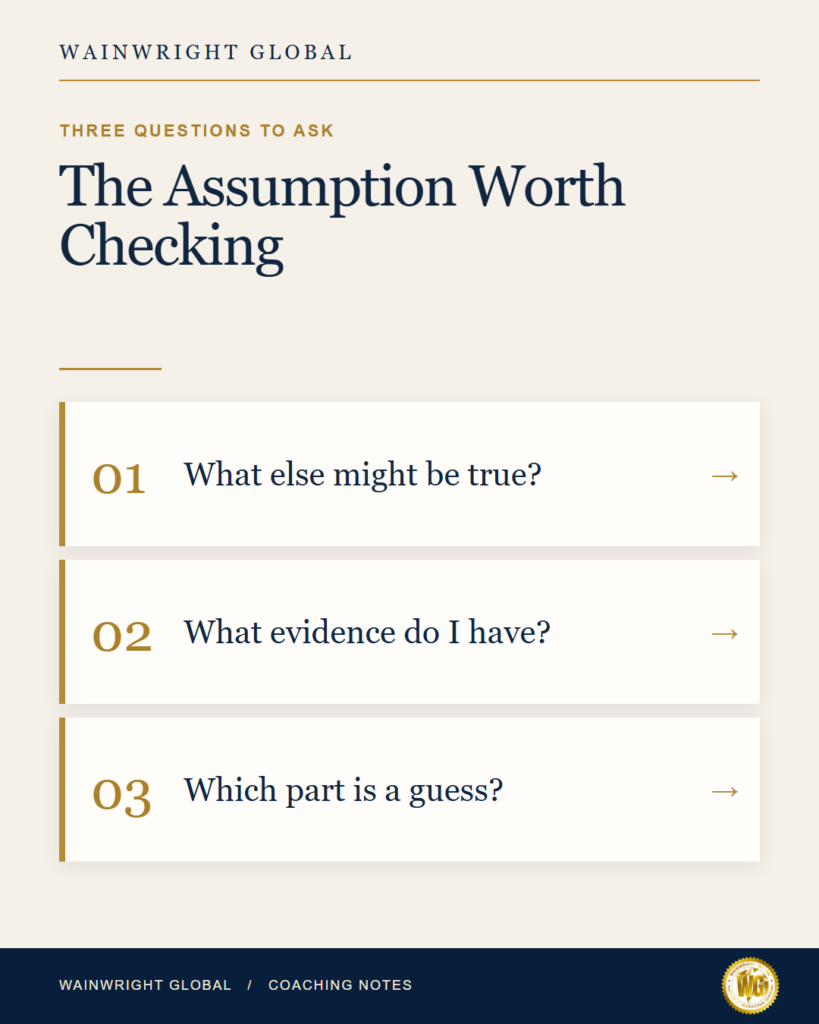
Coaching can slow that pattern down with a few simple questions. What else might be true? What evidence do you actually have? What part of this is a guess?
For example, someone might assume their manager is unhappy with their work because a meeting was cancelled. When they check the assumption, they may realize there are many other explanations, and that the simplest next step is to ask.
Those questions do not erase the problem, but they can remove unnecessary drama. They help people respond to what is actually happening rather than to the story they have built around it.
This takes practice, especially when emotions are high. It can help to write the assumption down and then list two or three other possible explanations.
When the assumption gets lighter, the next step often becomes more practical, and the conversation that follows usually goes better too.
Explore coach training at wainwrightglobal.com.